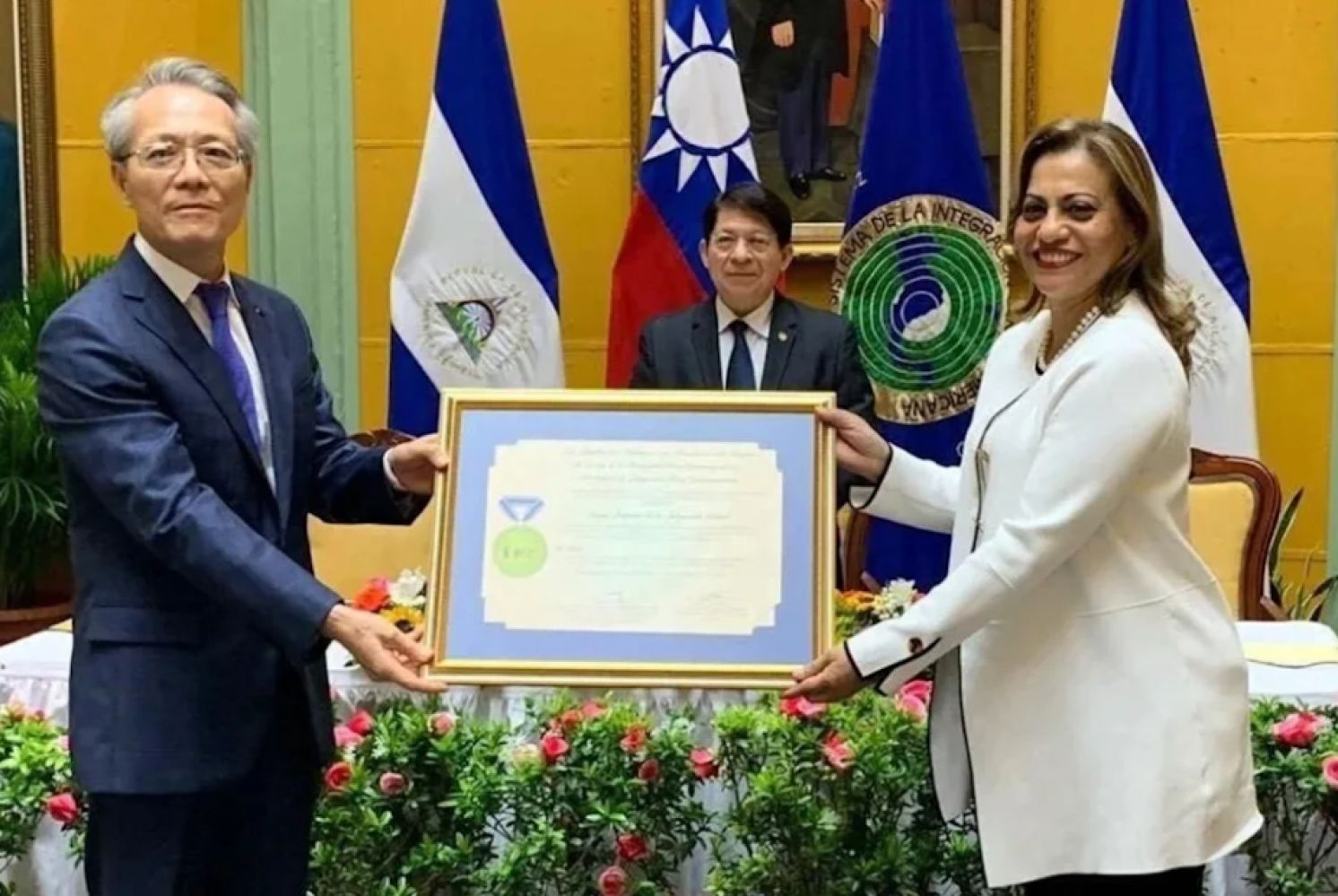
Behind Nicaragua's Diplomatic Break: Tsai Administration's Foreign Policy Mistake
By Hsu Mien-shen, China Times Commentary, October 1, 2026
Media reports recently noted that former Ambassador to Nicaragua Wu Chin-mu, in his posthumously published memoir A Clear Yet Resonant Voice: Echoes of Wu Chin-mu’s Diplomatic Career, denied allegations that he had known about Nicaragua’s decision to sever diplomatic relations with Taiwan but failed to report it. He argued that the real turning point in the rupture came after Nicaragua’s presidential election on November 7, 2021, when Taiwan chose to follow the U.S. position and did not congratulate Daniel Ortega on his re-election, ultimately prompting Nicaragua to turn toward Beijing.
The United States accused President Ortega, who was seeking reelection, of suppressing opposition figures during the election campaign and thereby securing victory, and therefore refused to recognize the election result. Nicaragua is a sovereign and independent country, and its presidential election is purely an internal affair. Whether the election was fair and whether its outcome was acceptable were matters that only the Nicaraguan people were entitled to decide, and other countries had no place interfering. American accusations against Mr. Ortega and its refusal to recognize the election result were themselves open to question. Yet the United States is the world’s dominant power. Relying on its unmatched military, economic, and financial strength, it exercises long-arm jurisdiction around the world, leaving others with little recourse.
After Mr. Ortega won the election, the administration of then-President Tsai Ing-wen did not immediately offer its congratulations, already departing from international convention, particularly given that Nicaragua was one of Taiwan’s few remaining diplomatic allies. Moreover, after the election, the Ministry of Foreign Affairs under the Tsai administration publicly called on “the Nicaraguan government to follow democratic mechanisms in handling disputes with different political parties or individuals holding differing views, in a manner consistent with the interests of the country and its people.” This statement was tantamount to accusing Mr. Ortega and the Nicaraguan government of acting in a manner inconsistent with democratic principles.
In diplomatic work, foremost among taboos is interference in another country’s internal affairs. By directly commenting on Nicaragua’s presidential election, the Ministry of Foreign Affairs committed a major diplomatic taboo. The United States, as the world’s dominant power, can openly interfere in other countries’ domestic affairs. Taiwan, by contrast, had what standing or status to express an opinion on Nicaragua’s election?
Regarding claims that Taiwan chose to follow the U.S. position on not offering congratulations, there were likely two possibilities. One was that the United States signaled to the Tsai administration that it should adopt a position consistent with Washington’s. The other was that the Tsai administration read the situation and voluntarily echoed the U.S. response. If it was the former, it would indicate that the Tsai administration obeyed the United States unquestioningly, followed Washington’s lead in all matters, and had no independent diplomatic considerations of its own.
Nicaragua is of little significance to U.S. foreign policy, but it was one of Taiwan’s few remaining diplomatic allies. By offending Nicaragua merely to align itself with the United States, did the Tsai administration expect Washington to repay the favor by helping Taiwan secure more diplomatic allies, or even gain admission to the United Nations in one stroke? If it was the latter scenario, then the administration simply did not know its own limitations, and only “foolish” could describe it.
Ambassador Wu retired from his post on November 17, 2021. After the new Ambassador Li Yueh-jung arrived in Nicaragua to take up his post, the Nicaraguan government unilaterally announced on December 10 of the same year that it was severing diplomatic relations with Taiwan. Wu wrote in his book that until the day he left office, Taiwan-Nicaragua relations remained stable, with no obvious signs that diplomatic ties were about to change. He was therefore also deeply shocked when news of the rupture came in December.
The following day, the Nicaraguan government granted Ambassador Wu Nicaraguan citizenship, an obvious move intended to humiliate the Tsai administration. It was as if Nicaragua were telling President Tsai: Your country’s governing authorities mishandled diplomacy and hurt the feelings of our government and people. But Ambassador Wu, whom your country appointed, performed outstandingly and was highly regarded by the Nicaraguan government and people. The severing of diplomatic relations had nothing to do with Ambassador Wu, and we therefore welcome him as a Nicaraguan citizen even after diplomatic ties have been broken. The Tsai administration’s performance and the accusations directed at Ambassador Wu by relevant figures were, as the media put it: when the government suffers a diplomatic failure, it shifts the blame onto its working-level officials.
The author is former ambassador of the Republic of China (Taiwan) to Haiti.
From: https://www.chinatimes.com/opinion/20261001004999-262104?chdtv